
Plugins Overview
Plugins & Extensibility
Ciaren is plugin-first. Almost every capability — the nodes on the canvas,
the databases you connect to, the engine your flow runs on, the code it exports —
is defined as a versioned provider contract that a plugin can implement. A plugin
is a small Python package that depends only on the public plugin API
(app.plugin_api), never on Ciaren's internals.
That means the core stays lean and open, while the community can extend it from the outside — without forking.
Ciaren's open core intentionally ships a focused set of built-in capabilities. Long-tail connectors, SaaS-specific integrations, and organization-specific workflow nodes should live as plugins maintained by their authors or community, not as ever-growing core surface area.
In one sentence
If Ciaren doesn't do something you need, you can add it as a plugin — and ship it as a portable, optionally signed package.
What you can extend
Each row below is a real interface in app.plugin_api. A single plugin can
implement one or several of them.
| Extension point | Provider contract | What a plugin can add |
|---|---|---|
| Nodes | NodeProvider | New canvas nodes that run end-to-end — preview, run, and Python code export. Sidebar forms render from the node's config_schema |
| Connectors | ConnectorProvider | New database / API / storage sources and sinks, with runtime behavior: test, list tables/objects, and read/write through the SQL & storage nodes. Connection forms render from the connector's metadata + config_schema |
| ML model types | ModelProvider | New trainable model types that appear inside the core Train nodes' model picker and train/log/export through the core ML pipeline |
| Storage | StorageProvider | New object/file storage backends |
| Execution engines | ExecutionProvider | New dataframe engines beyond the built-in polars and pandas |
| Exporters | ExporterProvider | New code/artifact export targets (e.g. notebooks) |
| Validators | ValidatorProvider | New data-quality / contract checks |
| AI capabilities | AIProvider | Pipeline builders, debuggers, optimizers |
| Authentication | AuthProvider | New authentication methods |
Plugin train nodes get first-class ML support too: a node can declare typed
model output handles, persist fitted models through the host's MLflow-backed
ModelStore, and emit model references that the core Predict / Feature
Importance nodes consume — see ML Model Plugins.
Status note. The built-in catalog ships nodes, connectors, storage, the polars / pandas engines, and the ML model catalog; plugins can execute nodes, connectors, and model types end-to-end. The remaining contracts (engines beyond the defaults, custom exporters/validators, AI capabilities, and auth methods) are defined extension points designed for plugins — they are how Ciaren grows without bloating the core. The plugin API is versioned but still alpha: contracts may change between releases until 1.0.0 (a plugin declares the
api_versionit targets, and the loader rejects incompatible ones before import). Always check the API reference for what the running instance currently exposes.
How a plugin is discovered
Ciaren finds plugins two ways:
- Local directory — point
CIAREN_PLUGINS_DIRat a folder of plugins (great for development, no install needed). - Installed package — a plugin that declares the
ciaren.pluginsentry point is discovered automatically oncepip install-ed.
Fresh installs also include a small bundled Explore catalog with the Hello
Plugin and MLP Classifier example packages. Bundled catalog entries are not
loaded automatically: they are shown as installable examples so users can try the
install and approval flow.
Set CIAREN_MARKETPLACE_INDEX=none to hide Explore, or point it at your own
marketplace JSON.
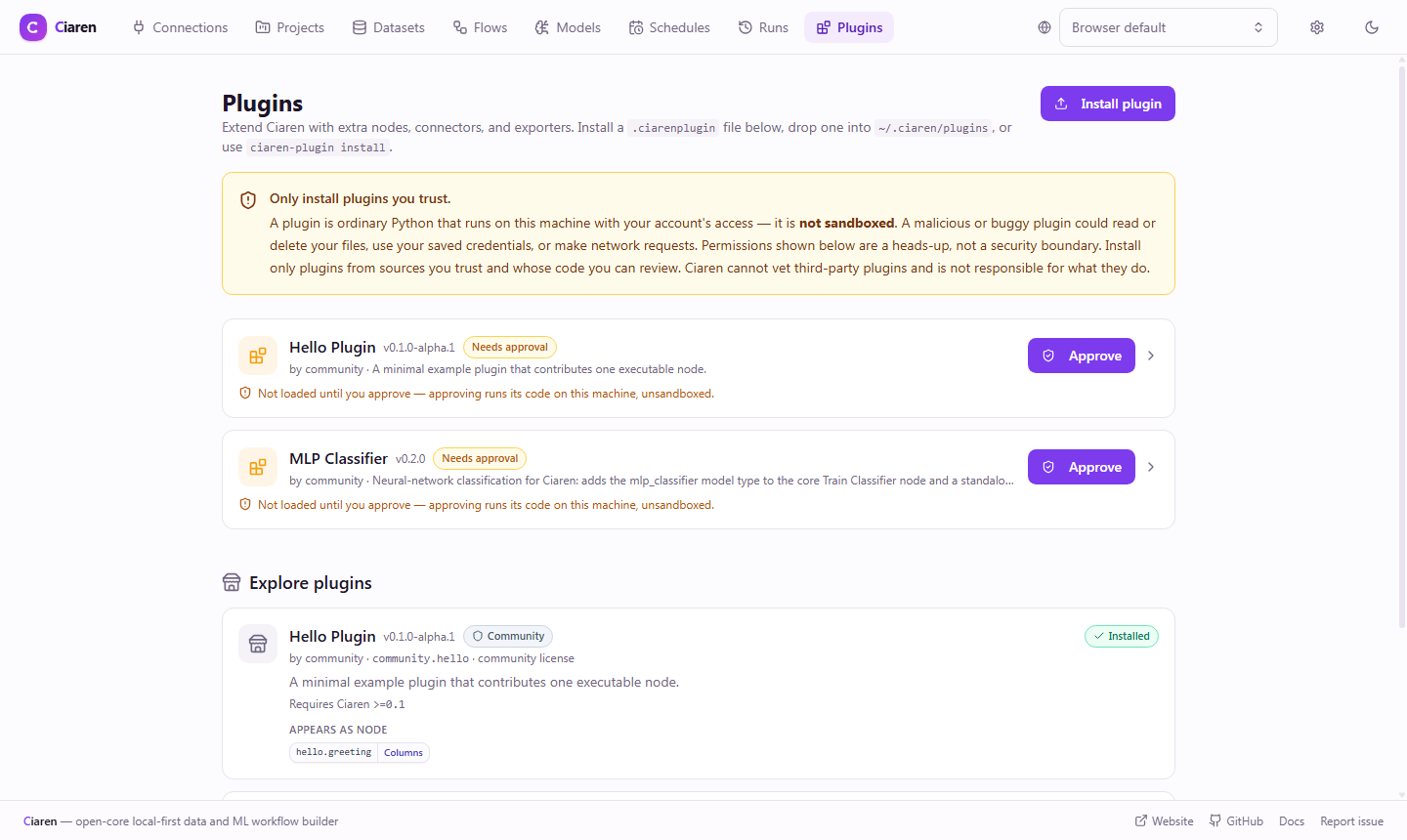
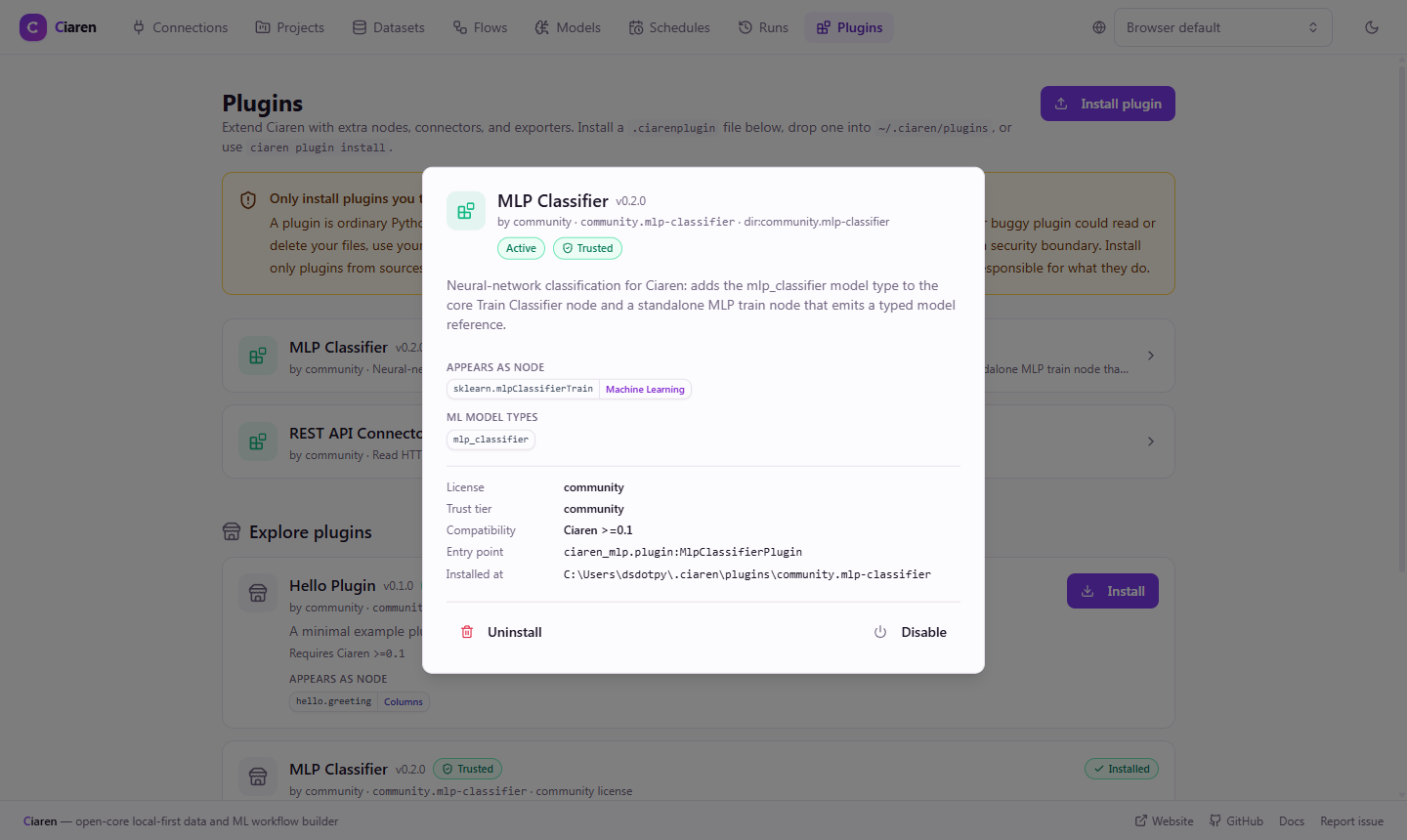
Once installed and approved, plugins show what they contribute — nodes, ML model types, connectors — with trust and signature badges:
# Develop against a local folder
export CIAREN_PLUGINS_DIR=/path/to/your/plugins
ciaren serve

# Inspect what's loaded
ciaren-plugin list
Disabled plugins and plugins with ungranted permissions are not imported until you approve them — code never runs behind your back. See Plugin Security & Permissions.
Packaging & signing
Plugins can be packaged as portable .ciarenplugin files and cryptographically
signed (Ed25519). Installing with --trusted refuses any package not signed by
a key you trust.
# Publisher: generate a key, package, and sign
ciaren-plugin keygen
ciaren-plugin pack ./my-plugin ./my-plugin.ciarenplugin
ciaren-plugin sign ./my-plugin.ciarenplugin \
  --key <private_hex> --key-id acme-2026 --publisher acme

# Consumer: install only trusted, signed packages
ciaren-plugin install ./my-plugin.ciarenplugin --trusted
ciaren-plugin verify  ./my-plugin.ciarenplugin
See Packaging & Distribution for the full publisher workflow.
Complete, runnable examples
Two example plugins live in the repository, both shipped as pre-built signed
packages in examples/plugins/dist/
and bundled into the Explore catalog so a fresh install lists them ready to install:
- Hello plugin — the smallest node that runs end-to-end. Start here → Build Your First Plugin.
- MLP Classifier plugin — neural-network classification both ways: a model type inside the core Train Classifier picker, and a standalone train node that persists to MLflow and emits a typed model reference. Walk through it → Build an Advanced Plugin and ML Model Plugins.
Reading plain HTTP APIs needs no plugin at all — that's the built-in REST API connector. Build a connector plugin for sources beyond it.
Where this is heading
These contracts are the foundation for a community ecosystem of nodes, connectors, execution engines, exporters, AI assistants, templates, and integrations. The core stays open and useful on its own; extensions install from the outside.
If you want Ciaren to support a new external system, start by building a plugin. If the Plugin API blocks that work, open an issue for the SDK gap rather than a request to add the system directly to core.
Next steps
- Installing & Managing Plugins — install, approve, disable, and uninstall
- Build Your First Plugin — a 10-minute, step-by-step tutorial
- Writing a Plugin — the full contract, events, and rules
- ML Model Plugins — model types, train nodes, and model references
- Connector Plugins — database/API/storage connectors with runtime behavior
- Packaging & Distribution — package and sign
- Build an Advanced Plugin (scikit-learn) — hyperparameters, validation, and code export
- Plugin API Reference — every provider, spec, and method
- Plugin Manifest — the manifest schema
- Plugin Security & Permissions — the trust model
- Catalog & Plugins API — inspect what an instance exposes
Built something useful? Open a Discussion to share it with the community.